
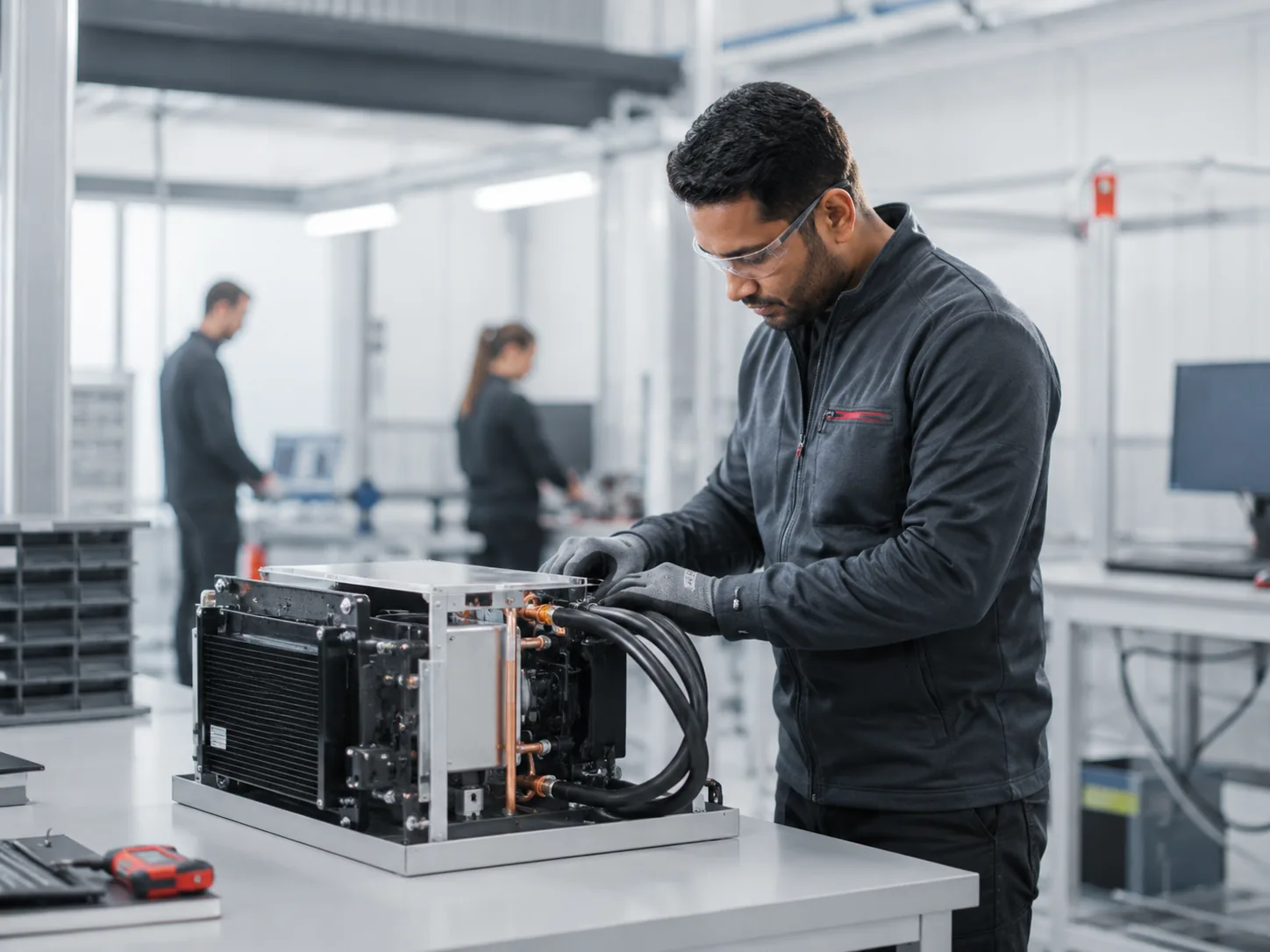
Before pilot supply or production release, liquid cooling programs benefit from a structured engineering review. The purpose of this review is not only to approve a component, but to confirm that the complete cooling arrangement is feasible inside the target application.
Mechanical fit
Teams should verify space claim, routing path, connector orientation, installation clearance, and any access needed for mating, disconnection, or maintenance. Mechanical fit is often the first gate because constraints inside AI hardware are rarely forgiving.
Fluid performance
Flow path design affects pressure drop, balance across branches, and long-term cooling stability. Review should consider connection count, path complexity, hose routing, and the effect of serviceable interfaces on the liquid loop.
Material and coolant compatibility
Material selection should match the intended operating environment. That includes metal selection, seal material choice, and any compatibility considerations linked to coolant formulation, temperature range, or expected service life.
Implementation feasibility
Even if a design appears technically sound, teams should ask whether it can be assembled consistently, labeled clearly, reviewed efficiently, and scaled through pilot and production phases. Feasibility review helps prevent late-stage surprises.
Why this matters
System-level review creates a shared decision framework across engineering, sourcing, and operations. It improves communication, reduces iteration, and creates a cleaner path from prototype discussion to production planning.
Aegival supports this review logic by focusing on integration feasibility: how interconnects, fluid routing, manifolds, and thermal interfaces work together in a real implementation context.